Spitsbergen in the Svalbard archipelago is world famous for producing marine fossils from the beginning of the Age of Dinosaurs. These are preserved in rock layers that were once mud at the bottom of a sea stretching from mid-to-high palaeolatitudes and bordering the immense Panthalassa Super-ocean. Most spectacular are the remains of bizarre marine reptiles and amphibians, which represent the earliest adaptive specialization of land-living animals for life in offshore habitats.
Textbooks suggest that this landmark evolutionary event took place after the most catastrophic mass extinction in Earth History, some 252 million years ago. Termed the end-Permian mass extinction, this ‘great dying’ wiped out over 90% of all marine species, and was driven by hyper-greenhouse conditions, oceanic deoxygenation, and acidification linked to massive volcanic eruptions initiating breakup of the ancient Pangaean supercontinent.
Timing the recovery of marine ecosystems after the end-Permian mass extinction is one of the most debated topics in paleontology today. The long-standing hypothesis is that this process was gradual, spanning some eight million years, and involved a step-wise evolutionary progression of amphibians and reptiles successively invading open marine environments. However, the discovery of the new and exceptionally rich fossil deposit on Spitsbergen has now upended this traditional view.
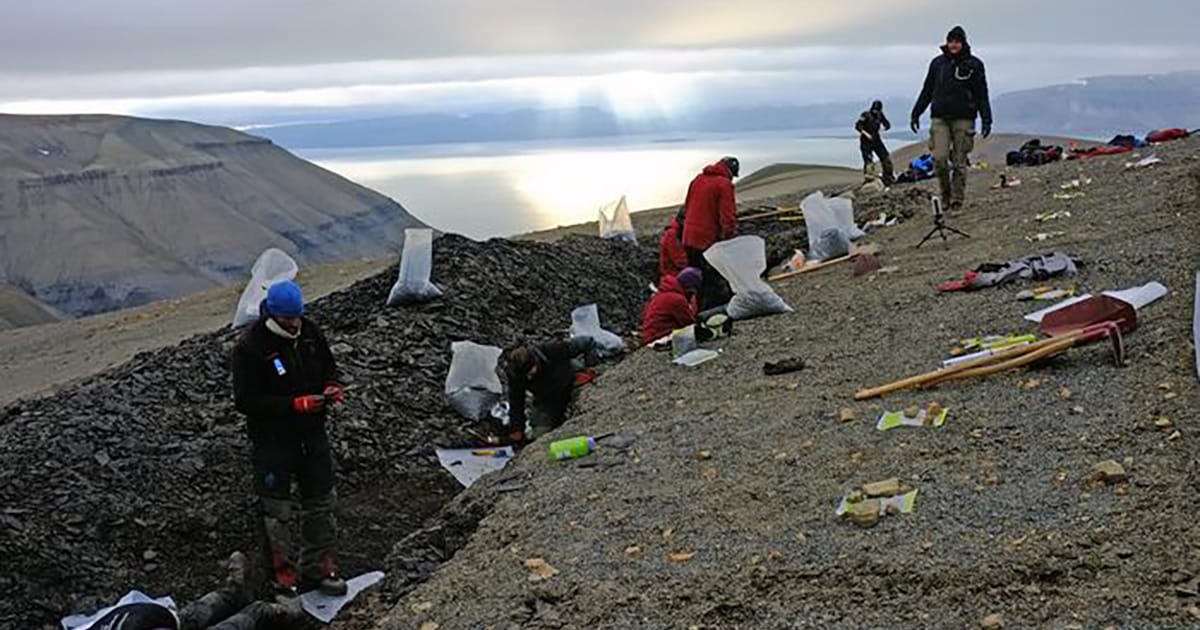
The Spitsbergen fossil deposit is so dense that it actually forms a conspicuous bonebed weathering out along the mountainside. This accumulated over a very short geological timeframe, and therefore provides unprecedented insights into the structure of marine communities from only a few million years after the end-Permian mass extinction. Stratigraphic dating has pinpointed the age of the Spitsbergen fossil bonebed to around 249 million years ago. Careful collection of the remains from 1 m2 grids covering 36 m2 has also ensured that over 800 kg of fossils, including everything from tiny fish scales and shark teeth to giant marine reptile bones and even coprolites (fossilized feces) were recovered.
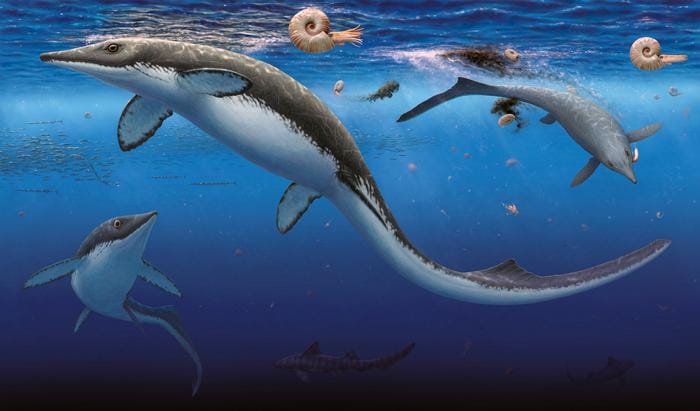
The Spitsbergen fossil bonebed reveals that marine ecosystems bounced back extremely rapidly, and had established complex food chains with numerous predatory marine reptiles and amphibians by as little as three million years after the end-Permian mass extinction. Most surprising is the sheer diversity of fully aquatic reptiles, which includes archosauromorphs (distant relatives of modern crocodiles) and an array of ichthyosaurs (‘fish-lizards’) ranging in size from small squid-hunters less than 1 m long to gigantic apex-predators exceeding 5 m in length.
A computer-based global comparative analysis of the various animal groups further highlights the Spitsbergen fossil bonebed as one of the most species-rich marine vertebrate (backboned animal) assemblages ever discovered from the dawn of the Age of Dinosaurs. It also suggests that the origins of sea-going reptiles and amphibians are much older than previously suspected, and likely even preceded the end-Permian mass extinction. This ‘ecosystem reset’ would have opened new feeding niches, and ultimately, laid the foundations for modern marine communities as we know them today.
The paper is published as a cover feature in the prestigious international journal Science. Ancient marine reptile fossils from Svalbard are on public display at the University of Oslo Natural History Museum and Swedish Museum of Natural History.