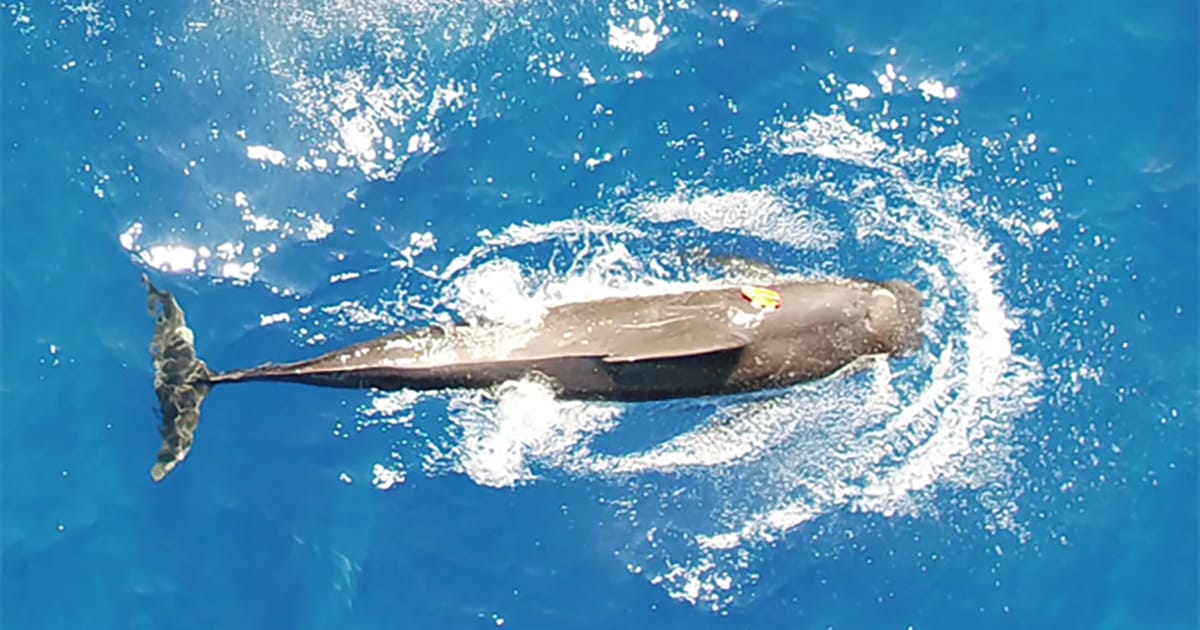
How much food an animal needs to consume on a daily basis is a crucial part of the jigsaw of life, helping us to recognize when a species might be at risk if their food supply dwindles, and one enigmatic group of animals is the pilot whales, which dive to depths of up to 1,700 m as they forage, mainly for squid.
“These animals have been studied in locations around the world, but relatively little is known about them in Hawaiian waters,” said William Gough (University of Hawaiʻi at Mānoa, USA), who teamed up with colleagues to solve the riddle of just how much Hawaiian squid short-finned pilot whales consume.
First, the team headed out into the Pacific Ocean, where they attached data-collecting tags with a detachable suction cup to eight short-finned pilot whales.
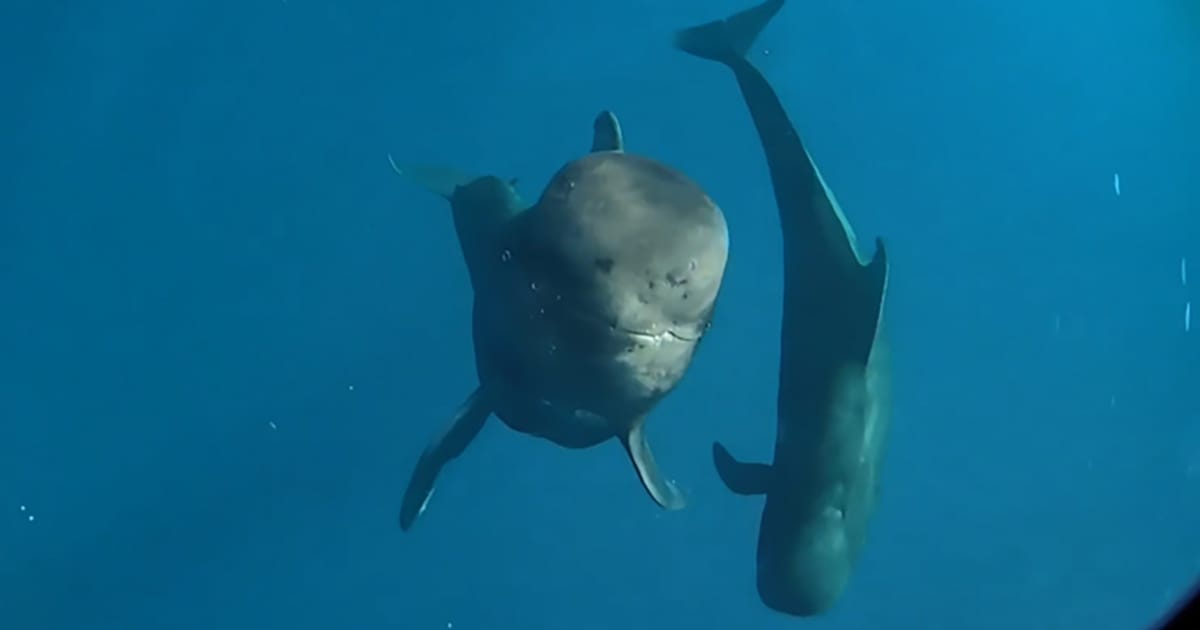
“Short-finned pilot whales are fairly small and quick, so we really have to pick our moment,” recalled Gough, adding that each tag was equipped with motion sensors, a camera with a light, hydrophones to record echolocation clicks, and GPS.
“Ideally, we attached the tag right behind the blowhole facing the head, so we could see any foraging at depth,” said Gough.
In addition, the team hovered a drone 25 m above each whale, filming so that they could figure out the animal’s size.
Retrieving the tags, which sometimes floated 50 miles in rough waters after detaching, Gough found that the whales had made 118 deep dives, going down as far as 864 m, with each whale diving approximately 39 times a day.
The researchers then analyzed the whales’ tail beats as the animals descend and calculated that short-finned pilot whales use 73.8 kJ/min of energy while diving and only 44.4 kJ/min when at the surface. But what would that equate to in terms of the number of squid that the whales would need to consume to survive?

Listening for the tell-tale echolocation clicks on the hydrophone recordings as the whales intercepted a squid, the team estimated that the whales consume approximately 4 squid per dive and that each squid provides around 560 kJ of energy when digested.
Gough then calculated that each whale must eat between 82 and 202 squid per day, totaling as many as 73,730 squid per whale per year.
But how many squid does the whole population of short-finned pilot whales around Hawaiʻi actually consume over a year? Based on estimates that the population is up to 8,000 individuals, the team calculated that the pilot whales together consume as many as 88,000 tonnes of squid each year, which is, fortunately, a drop in the ocean for the local squid population.
“These results show that short-finned pilot whales are in relatively good shape in Hawaiʻi, having found an abundant and reliable source of food,” said Gough, who is optimistic about the future of Hawaiian pilot whales.