“There are a lot of different ways that fish go about producing and using light,” said lead author Dr. Todd Clardy, Collections Manager of Ichthyology at the Natural History Museum of Los Angeles County. “One of the things that we wanted to do was find out how this species of fish was using the light it produced. Part of that was by examining the structure of the photophore and not just how they looked at the cellular level, but we examined the size and the distribution of them across the body of the fish to try to assess what this fish was doing with these cool photophore organs, and it turns out they’re using it as counter illumination.”
While most of us might think of bioluminescence as an attractor—picture anglerfish luring prey with light in the depths—Clardy and his teammates found that V. mabahiss used its light to hide. Counter illumination is a kind of camouflage where an animal produces light to make itself harder to be seen by predators.
“We live in basically a two-dimensional world,” said Clardy. “I never think of looking for a cheeseburger up above me. But fish are always looking up for a shadow passing over them because it’s either going to be food or a predator.” Counter illumination breaks up that shadow to mimic the light of the surface. “The fish is camouflaged, almost invisible.”
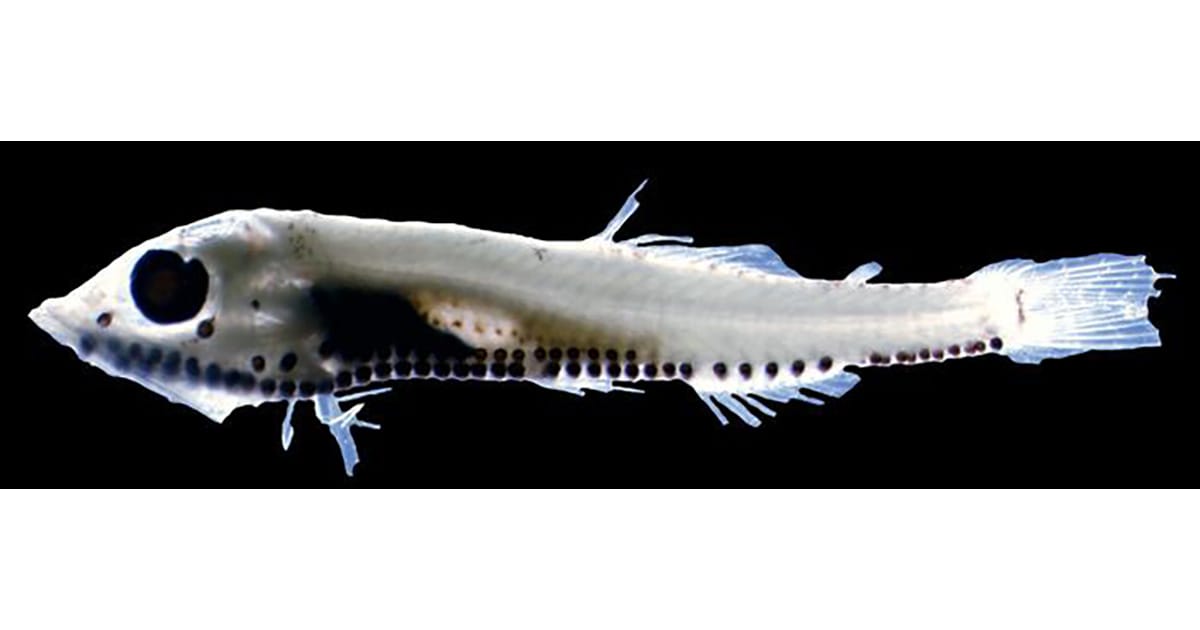
Clardy and his team found that V. mabahiss have between 140 and 144 photophores of varying sizes throughout their bodies, all pointed downwards. Each photophore produces a blue light, breaking up the silhouette of the fish and camouflaging them from any predator looking up. They looked at five juvenile V. mabahiss specimens to better understand how the fish used its light.
While the photophores varied in size, the researchers found that they all shared the same structure. The light is produced through a well-understood bacterial reaction, and the sophisticated composition of the photophores directs that bioluminescence into useful camouflage. “They have this thick pigment layer to block the light from entering the fish, reflective cells that amplify the light, and a lens that lets the light pass through,” said Clardy.
A small fish only known to the Red Sea, V. mabahiss lives deep underwater and is seldom encountered by people, so much so that it has no common name. The findings from this study will provide bedrock information for future researchers to study bioluminescence in fish. “Its rarity means that V. mabahiss may be difficult to collect for most researchers,” said Clardy. “We hope to provide information that other scientists can use for the broader study of bioluminescence.”