Imitation in Color and Shape
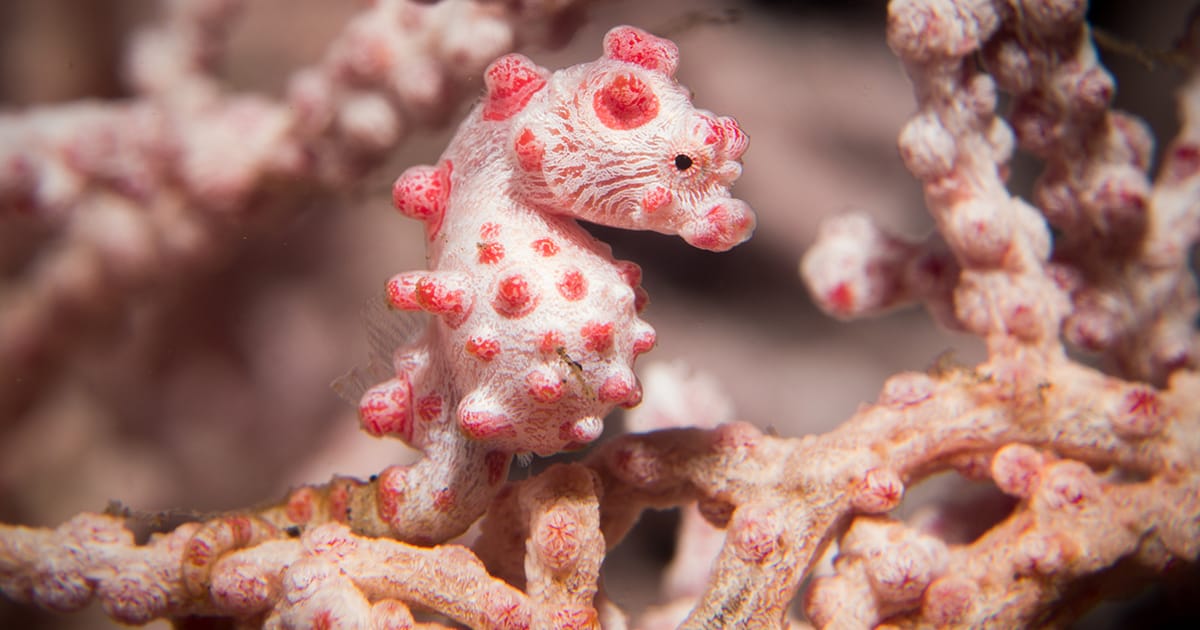
Just 45 years ago, pygmy seahorses were completely unknown. Thanks to their extremely good camouflage, they had simply not been discovered before. Today, knowledge of their biology is still fragmentary, as it is very difficult to find them or even keep them in aquaria. The color and structure of their skin correspond exactly to the coral to which they cling with their tails day and night, waiting for the food to swim by.
In the course of evolution, these animals have developed small knobs on their skin, which imitate the shape and color of the coral’s polyps, and even their snouts are shortened to the length of polyps, making them as inconspicuous as possible. “Seahorses usually have an elongated snout that resembles a horse (Greek “hippos”). Hence, the scientific name of seahorses: Hippocampus. However, this would set the pygmy seahorse apart from the coral’s shape. We were highly interested in finding out at what stage of development this deviating appearance of the pygmy seahorse is caused to provide good camouflage and which genes are responsible”, explains Axel Meyer. The professor of evolutionary biology at the University of Konstanz is the lead author of the study, jointly with Professor Lin Qiang from the Institute of Oceanology at the Chinese Academy of Sciences in Guangzhou, China. To get to the bottom of the question of which genes are responsible, the researchers and their team looked at the expression pattern of the pygmy seahorse’s genes at different stages of development of the snout region.
Eternal Baby Schema
In the early stages of development, the head of all seahorse species is still short and, together with the squat facial proportions, corresponds to the baby schema known since Konrad Lorenz. This cuteness factor at a young age is also known in mammals. “Normally, a combination of different genetic components causes the snout of a seahorse to grow proportionally faster than other parts of the body from a certain age and thus become elongated. In the pygmy seahorse, however, we have now discovered that these different growth rates are suppressed because the hoxa2b gene has been lost,” said Meyer.
Consequently, growth is not stimulated, and the snout remains knob-like. “We were also able to demonstrate this with CRISPR-Cas9 experiments on zebrafish. The head of the pygmy seahorse remains stuck in the ‘childlike’ earlier stage of development. This shape mimics the coral perfectly and makes it more difficult for predators to detect these animals on the coral,” Meyer explained. “With its short snout, the pygmy seahorse merges visually with the coral. A long nose, on the other hand, would stand out and make camouflage less perfect.”
Many Lost Genes
In addition to the shape of the head, the research team also investigated the genetic basis of the skin color, the formation of skin knobs, and the immune system of the animals. They discovered, among other things, that the pygmy seahorse has lost an unusually large number of immune genes in the course of its evolution, which split off from full-sized seahorses about 18 million years ago. They also found out that, when it comes to the immune system, these fish have the smallest known set of genes of all vertebrates.
“This is probably due to the fact that coral toxins can be tolerated by the pygmy seahorses and even provide them with protection against microbes. Consequently, their immune system no longer needs the corresponding genes. Furthermore, the sex roles of seahorses have been switched, as males incubate the eggs in their brood pouch. As, however, the eggs are not genetically identical to the cells of the male’s body, they would normally be attacked as foreign tissue. Losing immune-system genes was necessary to weaken the corresponding immune response,” said Meyer.
This makes pygmy seahorses a prime example of evolution: What is advantageous for survival prevails or is reinforced. What is disadvantageous or unnecessary, on the other hand, disappears over the generations. “In all of these adaptations, we see examples of massive gene losses and a seemingly paradoxical release of evolutionary creativity, which ultimately explains the unusual appearance and remarkable biology of these creatures,” concluded Meyer.