The research team set out to see if the presence of tiny ocean life, like microbes and plankton, could help to determine how many whales are in areas of the ocean off the California coast. The researchers wanted to understand if the “ecological habitat”, or community of small organisms associated with baleen whales, can improve their ability to predict baleen whale densities.
Erin Satterthwaite, one of the study’s lead authors, said her team discovered that microscopic ocean life can indeed be used to predict the density of baleen whales off the California coast.
The study used data from the world’s oldest marine ecosystem monitoring program, the California Cooperative Oceanic Fisheries Investigations (CalCOFI), now in its 77th year, to examine the relationship between baleen whales and their ecological habitat off the California coast from 2014 to 2020.
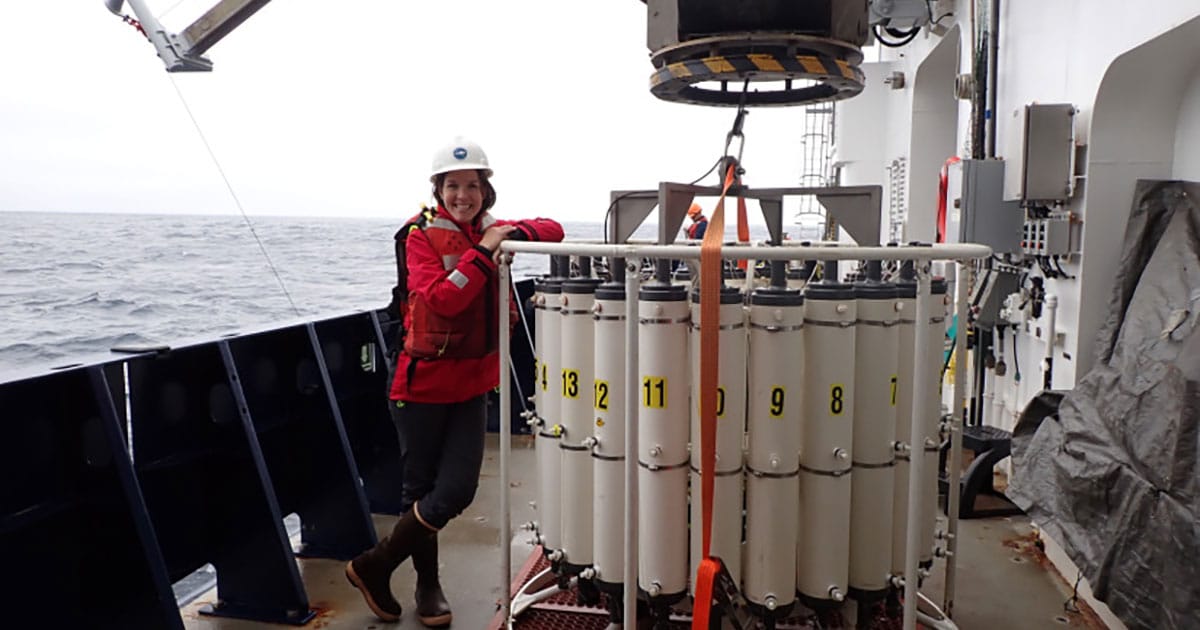
The scientists compared the whale survey data taken from visual observations with seawater samples analyzed for microbial and small plankton communities using environmental DNA, or eDNA. In this approach, seawater is filtered and DNA from organisms in the water is extracted. Specific genetic markers are then amplified and sequenced, allowing researchers to identify the suite of organisms present by matching sequences to reference databases. It’s a method of analysis akin to the drawing of blood from patients to reveal the state of their health. Here, the DNA in seawater reflects the ecological state of the ocean, effectively serving as a “fingerprint” of ocean habitat.
The team’s results suggest that tiny ocean life captured in seawater samples can act as indicators of the habitat supporting whales, including their food web connections.
“Many approaches rely on indirect environmental proxies that are several steps removed from the actual biology of the whales,” said Satterthwaite. “Our work uses eDNA to characterize the structure of the microbial and small plankton community which adds to existing oceanographic information by incorporating ecological habitat information of whales, which improves our ability to predict whale densities.”
Findings based on the study suggest that, on average, predictions of whale densities based on microbial communities were found to be 53% more accurate than traditional forecasts.
The work adds to a growing body of research using eDNA that gives scientists a window into the biology and ecology of the ocean. With whales, scientists are interested in monitoring their populations as a general indicator of ocean health, to better understand and manage human impacts such as vessel strikes, entanglement, and noise disturbance, and because they are culturally and ecologically important. Satterthwaite said that this work can help scientists to better understand how whales are connected to tiny ocean life, like bacteria, phytoplankton, and zooplankton.
As the cost decreases and the ease of using eDNA techniques improves, eDNA is becoming increasingly accessible for a wide range of applied purposes. More broadly, this approach could also be used to study other large marine animals, like sharks or large open-ocean fish, which could help create more detailed range maps of marine species.
“While our methods are not off the shelf, they remain transferable to prediction from microbial data more broadly,” said study co-lead author Trevor Ruiz, an assistant professor of statistics at Cal Poly, “and along with our scientific findings we have provided a portable software implementation of the methods to lower barriers to adoption for other researchers who might be interested in applying our approach to other problems.”
The study, “Microbial and small zooplankton communities predict density of baleen whales in the southern California Current Ecosystem”, appears May 6, 2026, in the journal PLOS One. Co-authors include Nastassia Patin, Michaela Alksne, Julie Dinasquet, Robert Lampe, Andrew Allen, Simone Baumann-Pickering, and Brice Semmens of Scripps Oceanography; Trevor Ruiz, Katherine Chan, and Nicholas Patrick of Cal Poly, and Len Thomas of the University of St. Andrews in Scotland. Lampe and Allen are also affiliated with the J. Craig Venter Institute in La Jolla, Calif. The Office of Naval Research, NOAA, and the Simons Foundation were among the chief funders of the research used in this study.