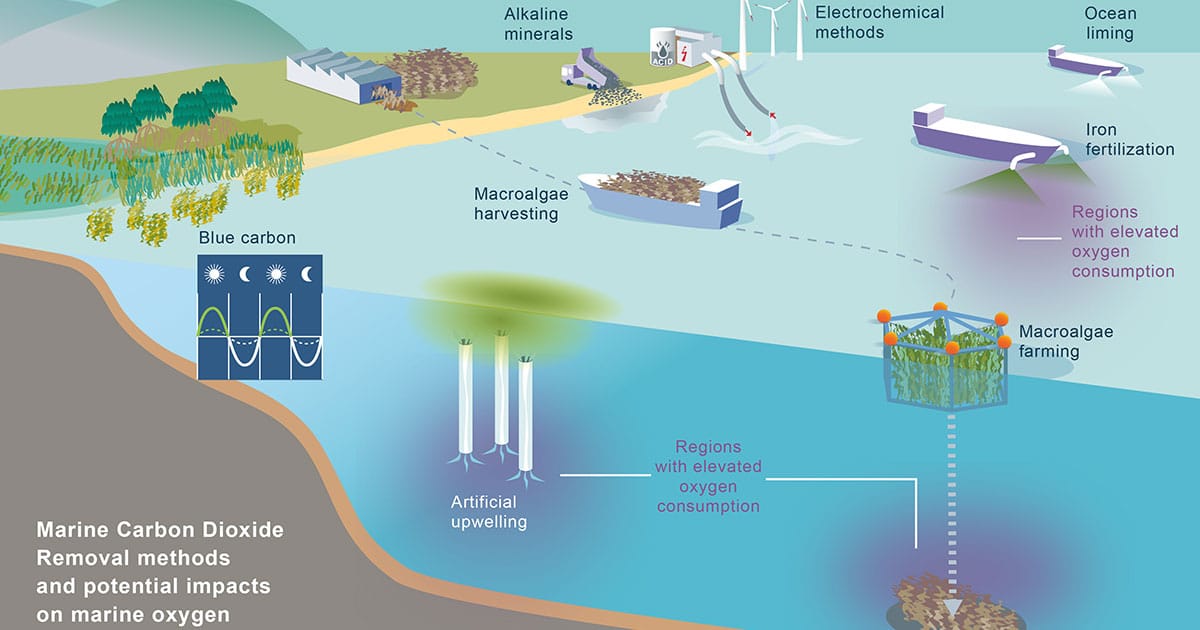
“What helps the climate is not automatically good for the ocean,” said Prof. Dr Andreas Oschlies, lead author of the study and head of the Biogeochemical Modelling research division at GEOMAR. Together with an international team that is part of the UNESCO Global Ocean Oxygen Network (GO2NE), he conducted a comprehensive assessment using idealized global model simulations to analyze both the direct impacts of various mCDR approaches on ocean oxygen and their indirect effects through climate mitigation. The results have now been published in Environmental Research Letters.
Ocean Fertilization and Seaweed Sinking Among the Most Critical Approaches
The study identifies several biotic mCDR methods as particularly critical—including ocean fertilization, large-scale macroalgae farming followed by sinking of the biomass, and artificial upwelling of nutrient-rich deep water. These approaches involve the enhancement of photosynthetic biomass production, followed by its decomposition in the ocean interior. This remineralization process consumes oxygen—at levels comparable to the current rate of global deoxygenation caused by ocean warming.
“Methods that increase biomass production in the ocean and subsequently lead to oxygen-consuming decomposition cannot be considered harmless climate solutions,” said Oschlies. “Our model simulations show that such approaches could cause a decrease in dissolved oxygen that is four to 40 times greater than the oxygen gain expected from reduced global warming.”
By contrast, geochemical mCDR approaches that do not involve nutrient input – such as ocean alkalinity enhancement through the addition of alkaline substances based on limestone—appear to have minimal effects on ocean oxygen levels and are comparable to simply reducing CO2 emissions.
Among all methods examined, only large-scale macroalgae farming with biomass harvesting (i.e., removal from the ocean) resulted in an overall increase in oceanic oxygen levels. In this case, no additional oxygen is consumed within the marine environment, and the removal of nutrients limits oxygen consumption elsewhere. Model results suggest that if deployed at sufficient scale, this approach could even reverse past oxygen losses—providing up to ten times more oxygen than has been lost due to climate change within a century. However, the removal of nutrients would negatively impact biological productivity in the ocean.
Call for Systematic Monitoring of Ocean Oxygen
Given these findings, the authors advocate for the mandatory inclusion of oxygen measurements in all future mCDR research and deployment efforts.
“The ocean is a complex system which is already heavily under pressure,” said Oschlies. “If we intervene with large-scale measures, we must ensure that, no matter how good our intentions are, we are not further threatening marine environmental conditions that marine life depends on.”
Carbon Dioxide Removal as Part of Climate Strategy
Even with ambitious climate policy, Germany is expected to emit 10 to 20 percent of today’s greenhouse gas levels in three decades’ time—continuing to drive global warming. Carbon dioxide removal (CDR) is therefore being considered to help reach net-zero emissions. The ocean is the key player in the global carbon cycle due to its natural CO2 uptake and its huge storage capacity. However, these processes typically occur over long timescales. Marine Carbon Dioxide Removal (mCDR) approaches aim to accelerate these natural processes, thereby increasing the ocean’s carbon uptake capacity.