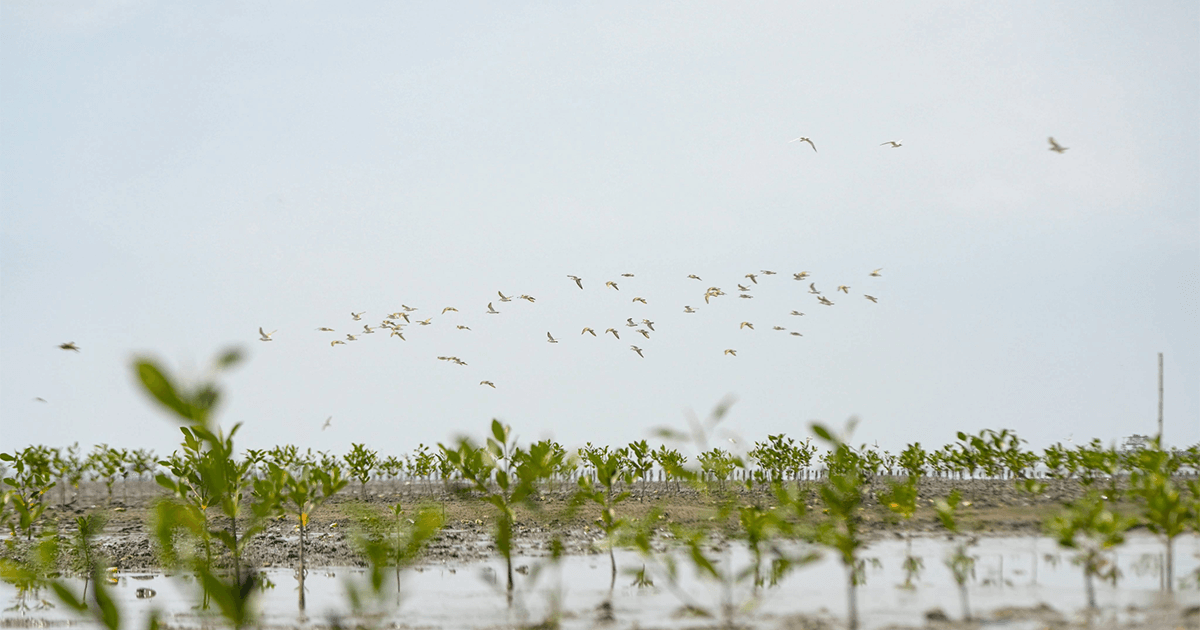
Mangroves are extremely valuable ecosystems: they store carbon, serve as water filters, are biodiversity hotspots, and protect coastlines from erosion and flooding. Remarkably, mangroves can store up to four times more carbon than tropical forests, making them powerful allies in the fight against climate change. By combining these functions, they significantly enhance the resilience of coastal communities. But since 1980, 50% of Ecuador’s mangroves have disappeared.
Blueprint for Mangrove Restoration
In 2023, Jan De Nul launched the AquaForest project together with partners from government, science and industry. AquaForest is intended as a blueprint for mangrove restoration, which can be implemented on a large scale and in different regions worldwide. The 50-hectare island in Ecuador is the first example.
Jelle Evenepoel, Manager of the Marine Environmental Department at Jan De Nul: “Our approach is based on innovative eco-engineering, tailored to the local ecosystem. This enables us to create optimal conditions for mangrove growth like soil quality, water dynamics, drainage, mangrove density, and the protection of young trees with temporary structures like permeable bamboo walls.”
Spectacular Growth and Survival Rate
At the end of last year, Jan De Nul completed the works and, together with local organizations, planted 12,000 trees and 10,000 seedlings. Another 11,500 seedlings were added in February 2025. A local expert in mangrove restoration, Fundación Calisur, monitors the growth and health of the mangroves every quarter. This shows that 90% of the trees and seedlings are surviving, which means some 30,000 trees are growing today.
In fact, they speak of the largest horizontal growth in their 16 years of mangrove restoration projects. They say this is due to the optimal conditions the island design creates for the mangroves. The growth index, based on the number of branches, leaves, and offshoots, is more than three times higher than what Fundación Calisur observes on average at other local mangrove restoration projects.
These findings highlight the importance of eco-engineering, a carefully designed ecosystem, and multidisciplinary collaboration in nature restoration projects.
Endangered Bird Species
Together with Ecuadorian university ESPOL and nature conservation organization Aves y Conservación, biodiversity on the island is also being monitored. To date, the partners have been able to observe 20 bird species there, including the Lesser Sandpiper and Wilson’s Sandpiper, which were listed as near-threatened species by the International Union for the Conservation of Nature (IUCN).
Besides bird species, ESPOL also conducts research on invertebrate organisms.
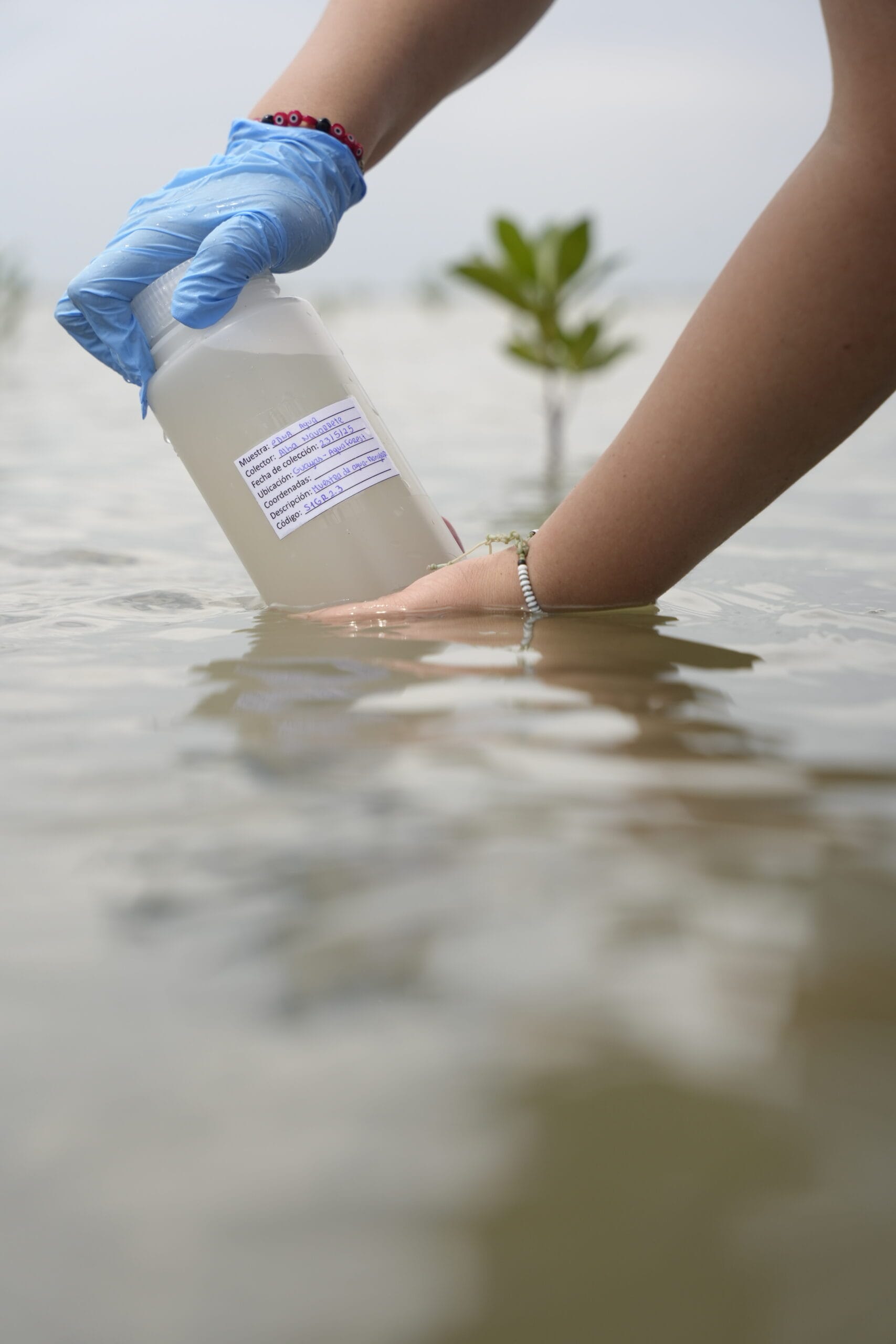
Andrea Reyes, Coordinator for AquaForest’s Monitoring Program at ESPOL: “During the site visits, we take samples in different places, which we examine in ESPOL’s laboratories to see which small and larger invertebrate organisms already live there. Already 20 species have been found, such as mollusks, ringworms, echinoderms, and arthropods. AquaForest is actually a living laboratory where you can see how a new ecosystem develops and forms. It is an open learning environment for our students.”
Source of Socioeconomic Activity
AquaForest also means added value for the local community in El Morro, where the island is located nearby.
Lucy Morales, President of the Women’s Association Asopromanglar: “We helped plant the seedlings and trees. Our members worked to build the permeable wall of bamboo, gaining new skills and earning an honest income. Our children learned at school about the importance of mangroves. And besides being a valuable ecosystem, this project is also a sustainable source of income for our crab fishermen, opens doors for ecotourism, and provides opportunities for the future of our region.”
AquaForest seems to be well on its way to achieve its goal: a sustainable and autonomous ecosystem where humans no longer need to intervene. In the coming months, the partners will continue to monitor the developments in this new ecosystem and make adjustments or repairs where necessary to provide the young mangrove trees with the necessary protection. And in the meantime, interest in the project is growing.
Vicky Stratigaki, Lead Engineer and Coordinator for AquaForest at Jan De Nul: “We are increasingly asked whether we can apply the techniques and methods we developed within AquaForest to other regions. The answer is yes! We always work together with local stakeholders to develop mangrove restoration efficiently and tailor it to local ecosystems. Mangrove restoration can make an important contribution to the fight against climate change. And with AquaForest, there is now a scalable and affordable solution.”