In a recent paper published in the journal Regional Studies in Marine Science, an international team of researchers estimated how much fish is caught by industrial fishing vessels operating in the Indian Ocean and carrying Automatic Identification Systems (AIS), which broadcast to other ships, land-based receivers or low-orbiting satellites the location, speed, and direction of these vessels. They found inconsistencies between the catch amounts derived from the AIS data and what these fleets or their home countries report to the Food and Agriculture Organization of the United Nations.
“Spain, France, and South Korea had AIS-derived catch estimates that were between 11 and 41 percent lower than the catches officially reported by these countries, suggesting these vessels may turn off AIS transponders to potentially elude detection either by authorities or for other operational reasons,” Dirk Zeller, senior author of the study and director of the Sea Around Us—Indian Ocean initiative at the University of Western Australia, said. “In contrast, Taiwan and China had six and four times more AIS-estimated catches than they reported. This suggests that these countries may not meet their international reporting obligations.”
To reach these conclusions, Zeller and co-authors at the Sea Around Us—Indian Ocean combined almost 500 country- and gear-specific catch rates obtained from over 80 sources with AIS satellite data provided by Global Fishing Watch. This data shows estimates of how many kilos are caught per fishing hour by each vessel.
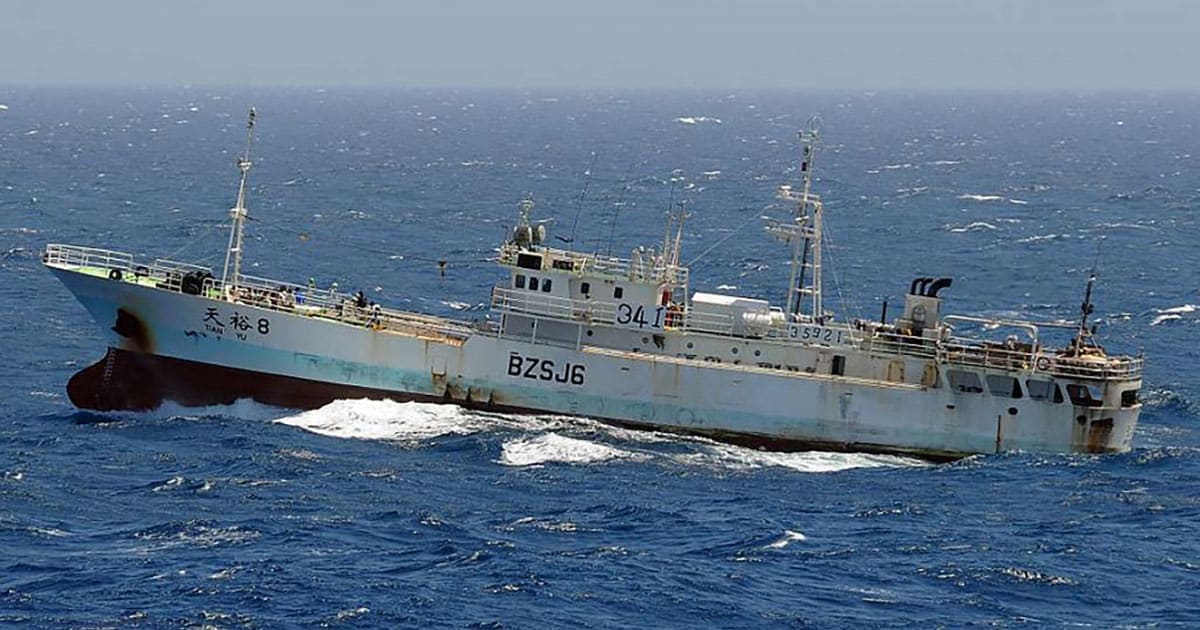
For the period spanning the years 2018 to 2020, AIS data identified vessels from 64 countries fishing in the Indian Ocean. These include 40 distant-water-fleet countries, 23 Indian Ocean Rim countries and one ‘unknown’ country group. Taiwanese and Chinese vessels were the ones spending the most time fishing.
Combined, distant-water fleets caught almost 60 percent of the total yearly industrial catch of the Indian Ocean, or approximately 220,000 tonnes per year. Ten countries took most of this bounty, with Taiwan’s fleet being responsible for 56 percent of the catch, China accounting for 32 percent, and Spain for 3 percent.
“These figures, however, are likely underestimations because both Taiwanese and Chinese fleets use AIS Class B devices, which have low wattage and weak signals that can be missed by satellite receivers,” independent researcher and lead author of the study, Paolo Cappa, said. “This is an issue particularly in the northern Indian Ocean.”
Out of the 40 distant-water fishing countries identified by AIS, only nine reported catches to the FAO, suggesting that the rest failed their international reporting obligations.
“The failure to comply, in this case, may be a result of at least some of these countries acting as ‘flag countries’ for these big fleets,” Zeller said. “This notion is reinforced by the lower catch figures reported by some countries like Spain, France, and South Korea when compared to the AIS-derived catch numbers, which point to potential reflagging, ‘flag hopping’ and the use of Flag of Convenience.”
Previous studies have shown that reflagging and Flags of Convenience aggravate catch misreporting issues and increase the risk of illegal, unreported, and unregulated fishing.
“Discrepancies between AIS-derived catch estimates and officially reported data underscore the challenges in fisheries monitoring and enforcement and highlight the lack of compliance enforcement by many flag countries,” Zeller said. “Addressing such problems is critical for effective fisheries management and ensuring compliance with international reporting obligations, both of which are fundamental to attempts at sustainability of fisheries resources in the Indian Ocean.”