The study was conducted by Australia’s national science agency, CSIRO, and the Australian Institute of Marine Science (AIMS), and provides new modeling-based evidence that zoning and fisheries management strategies adopted in 2004 are likely to have played an important role in recovering fish populations, reducing COTS outbreaks, and mitigating coral loss.
Dr. Scott Condie, CSIRO researcher and lead author, said COTS are one of the biggest threats to coral on the Great Barrier Reef, with multiple outbreaks of COTS occurring over the past four decades.
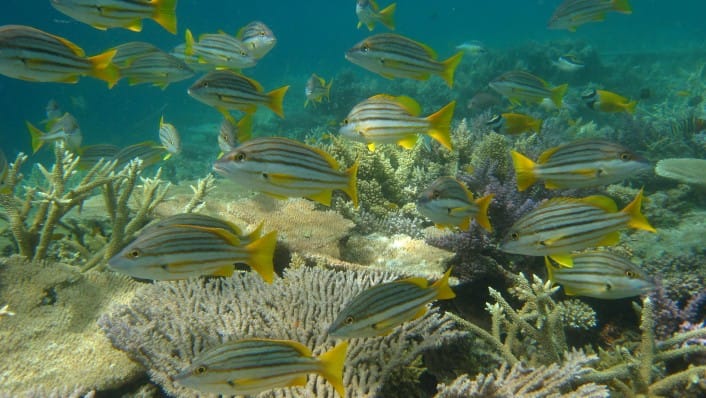
“Particular fish, like emperors, eat crown-of-thorns starfish. Protective measures, such as increasing no-take zones to 33 per cent, and tighter fishing regulations, were put in place in 2004 to protect these predatory fish,” Dr. Condie said.
“Our model shows that these initiatives likely averted a catastrophic tipping point that would have left the Great Barrier Reef with fewer large fish, resulting in continuous outbreaks of COTS and substantially less coral.
“Long term monitoring shows that the frequency of outbreaks across the Great Barrier Reef is consistently lower in protected zones.”
Dr. Daniela Ceccarelli from AIMS said these findings provide further evidence that protective measures have been working, highlighting the need for ongoing management and the critical role played by long-term monitoring.
“Model projections to 2050 show that without these fish protection strategies, there could be a four-fold increase in the percentage of reefs with COTS outbreaks,” Dr. Ceccarelli said.
“Without intervention over the last two decades, the model shows that grouper and emperor populations on the Great Barrier Reef would also have consistently declined under increasing fishing pressure.”
“This modeling is an important step towards understanding the potential for crown-of-thorns starfish management to protect the Great Barrier Reef under the increasing threat of climate change.”
The research also considered the benefits of direct COTS management on the Great Barrier Reef, which has evolved from manual removal of starfish at individual reef sites in the 1980s, to intensive culling at tourism sites, to the current COTS Control Program delivered by the Great Barrier Reef Marine Park Authority. Multiple vessels are deployed to more than 200 prioritized reefs across the Reef every year, with mounting evidence of the program’s effectiveness.
Published in Nature Ecology and Evolution, this research received funding support from the COTS Control Innovation Program, which is funded by the partnership between the Australian Government’s Reef Trust and the Great Barrier Reef Foundation.